CLAIM: CLOSE to 50,000 learners from both primary and secondary schools dropped out in 2024
SOURCE: newZimbabwe.com
VERDICT: Inconclusive
Online newspaper newZimbabwe.com made a claim that close to 50 000 learners from both primary and secondary schools dropped out in 2024.
This was attributed to Deputy Minister of Primary and Secondary Education, Angeline Gata, who told Parliament that 15 809 pupils dropped out of primary school, while 33 746 dropped out of secondary school, bringing the total to 49 555.
A check on the Parliament of Zimbabwe records, showed that, indeed, Gata made these remarks on 7 May 2025.
However, she did not say how her ministry sourced these figures.
Defining ‘school drop out’
The terms ‘school drop out’ and ‘out of school’ though similar, have different meanings.
Some definitions state that ‘school drop out’ refers to leaving school before the end of compulsory education, a point which varies from country to country. Other definitions state that dropout refers to ‘children who leave the educational system before completing their academic year. This means that they do not receive the final mark for that year or an official document proving that they finished that specific year of primary or secondary school’.
According to UNESCO, ‘out of school’ on the other hand, refers to the number of children and young people in the official age range for the given level of education who are not enrolled in pre-primary, primary, secondary or higher levels of education’.
The World Bank defines this as ‘the number of primary age children not enrolled in primary or secondary school’.
The Zimbabwe Education Amendment Act states that every child shall be entitled to compulsory basic state funded education. The Act defines basic education as ‘education from early childhood education up to the fourth form and any other category as may be declared as such by the minister by notice in the gazette from time to time’.
Available statistics
According to UNICEF, in 2024 the transition rate from Grade 7 to Form 1 in Zimbabwe was 79.5% transition. Based on this data alone, a significant number dropped out of school.
In 2023, 372 603 students wrote their Grade 7 examinations. If we use the UNICEF statistics of those who transitioned to Form 1 in 2024, it’s more than 75 000 drop outs. A figure with close to 30 000 difference before other drop out factors are considered for the year 2024.
The survival rate from Form 1 to Form 4 in 2024 was 80.6 percent.
The Census carried out in 2022 showed that out of the 3,699,558 females of school going age, more than 22 000 had dropped out of school between January and April of that year. Around 14 295 of these were between the ages of 4 and 18.
Of the 3,609,743 males of school going age, 18 049 had left school between January and April. About 11 400 of these were between the ages of 4 and 18. This brings the total number of school dropouts in the first four months of 2022 to around 25 600.
While attendance rates for urban scholars are generally higher than their agemates in rural areas, the propensity of attending school is higher for females than it is for males from age 4 to 12 and it is higher for males from age 13 to 24. The aggregated attendance rates for females are lowest in large scale commercial farms with 60.5 percent of school going age (4-24) currently attending school followed by resettlement areas with 63.3 percent and for males, state land has 57.2 percent followed by 58.9 percent for large scale commercial farms.
This is in contrast to numbers reportedly given by Primary and Secondary Education minister Torerai Moyo in 2024 that at least 50 000 pupils dropped out of school between 2021 and 2023. This would be 50 000 in 3 years compared to the 25 600 in 4 months from the census.
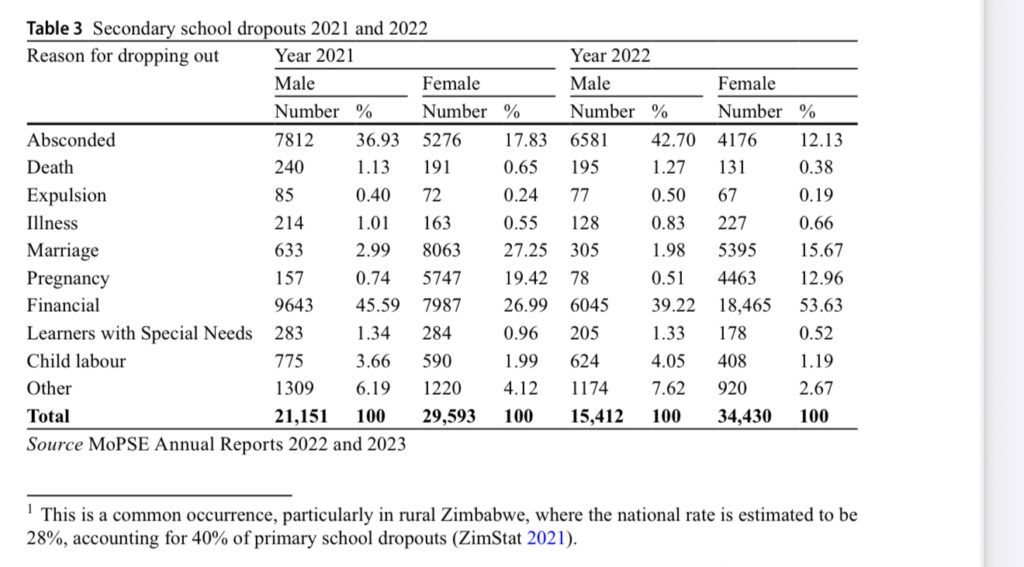
According to a research paper published in 2024, the statistics from the Ministry of Primary and Secondary Education showed that in 2022, 49 842 pupils dropped out of secondary school and 15 867 from primary school, bringing the total number of school dropouts in 2022 to 65 709.
Conclusion
The number of school dropouts and out of school children has been a subject of contention and debate in Zimbabwe due to varying statistics provided by both state and non-state entities. The evidence available is inconclusive on how many learners dropped out of primary and secondary school in 2024. It is also unclear what definition of school dropout is used by the Zimbabwean government, making it difficult to make a comparison of figures from state and non state actors.
This fact check was produced by Fungai Mutimodyo as part of a training exercise with the Friedrich Naumann Foundation.