CLAIM: At the moment, we do not have any law banning tinted windows on vehicles
SOURCE: Minister Ziyambi Ziyambi
VERDICT: Misleading
Zimbabweans woke up to an announcement from Permanent Secretary of Presidential Affairs and Devolution, Engineer Tafadzwa Muguti, this Tuesday during a Press conference that ‘We will not be allowing any commuter omnibus to have tinted windows… Please remove your tinted windows immediately, or the police will do it for you or your vehicle will be impounded.’
What has followed are contradictions and inconsistencies – all the way from the responsible minister down to the enforcers of the law.
Following the announcement, permanent secretary in the information ministry, Nick Mangwana, posted on X, ‘Why do people tint their cars? Is it for the sleek look, UV protection, or privacy or other nefarious objectives? Public transporters and private vehicles have been banned from having tinted windows.’
Hours later, presidential spokesperson, George Charamba, posted, ‘KINDLY NOTE: There is no basis in fact or law to the accompanying announcement attributed to Secretary Muguti. Kindly ignore this mis-communication from an unauthorized office and Officer!’
Then it was the home affairs minister himself with the claim, ‘At the moment, we do not have any law banning tinted windows on vehicles ‘ as quoted by the Herald. What the minister actually said was, ‘Mutemo watinawo ndewekuti kana motikari ichiisa tint isa isve zvekuti mutyairi anenge achi tyaira atadze kuwona. Izvozvo ndo mutemo watinawo. Zvemumarutivi emota hatisati tagara pasi (The law that is currently there is that when you tint your car, make sure that the driver’s vision is not affected. That’s the law we have. When it comes to the sides of the vehicle, we are yet to consult)’.
Lawyers also entered the fray.
@advocatemahere posted, ‘Muguti is not Zimbabwe. It does not matter who you are. You don’t legislate arbitrary, capricious, irrational rules from your office. Due process must be adhered to. Section 68 of the Constitution and the section 3 of the Administrative Justice Act require Govt to always act lawfully, reasonably and fairly. Until there’s valid legislation banning vehicle tints, his press remarks yesterday are ultra vires and therefore of no force or effect. The public is not bound by them. We need new leaders.🇿🇼’
Obey Shava, a human rights lawyer, posted, ‘This statement purports to ban tinted windows on Commuter Omnibuses & private vehicles. The police should be careful not to make costly decisions based on a statement which is not fully supported by the law. Tint is allowed on condition certain requirements are met. SI 129/15.’
There were also reports of motorists being ‘fined US$15 for having tinted windows’ by the police.
What is the legal position?
The admission of guilt traffic fine form posted shows the offence as ‘tinted or shaded windows’ under the RTA 129/15.
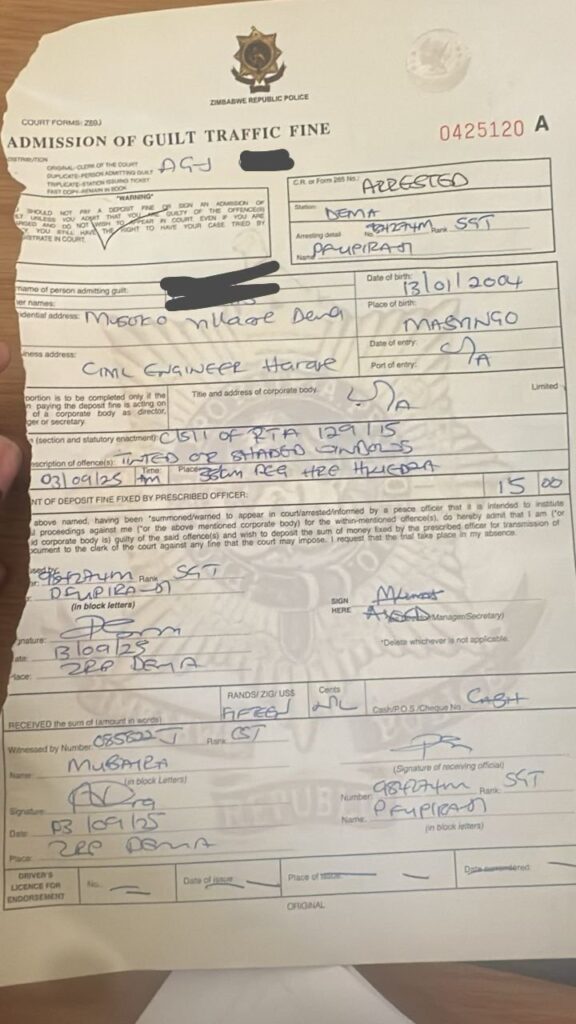
However, the police made a mistake here. There is no such thing as the RTA 129/15. RTA probably refers to the Road Traffic Act Chapter 13:11. The act does not address the issue of tinted or shaded windows. The 129/15 probably refers to Statutory Instrument 129 of 2015 dealing with Road Traffic (Construction, Equipment and Use) Regulations made in terms of Section 81 of the RTA.
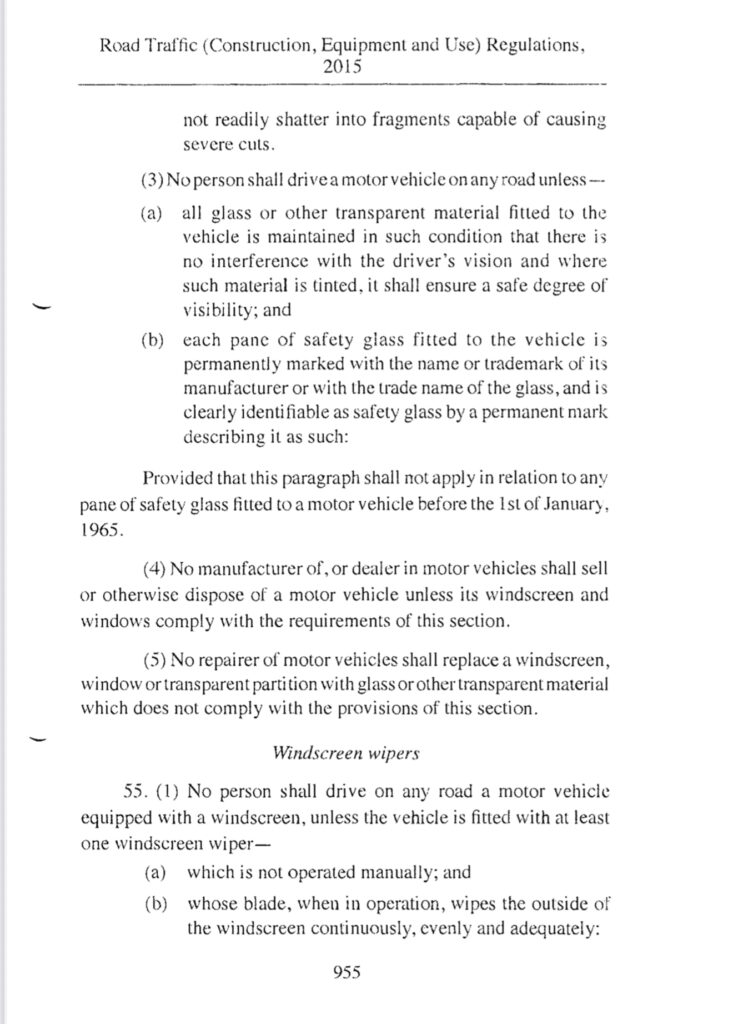
The SI states in Section 54, titled Windscreens and windows, that;
It is, therefore, clear that there is a law that sets conditions for tinted windows in motor vehicles. The relevant section states that, ‘No person shall drive a motor vehicle on any road unless–
(a) all glass or other transparent material fitted to the vehicle is maintained in such condition that there is no interference with the driver’s vision and where such material is tinted, it shall ensure a safe degree of visibility; and
(b) each pane of safety glass fitted to the vehicle is permanently marked with the name or trademark of its manufacturer or with the trade name of the glass, and is clearly identifiable as safety glass by a permanent mark describing it as such’.
It is important to note that where glass or other transparent material fitted to the vehicle is tinted, it shall ensure a safe degree of visibility and each pane of safety glass fitted to the vehicle is permanently marked with the name or trademark of its manufacturer or with the trade name of the glass, and is clearly identifiable as safety glass by a permanent mark describing it as such.
This implies that it is, therefore, an offence to drive a motor vehicle where the tint does not ensure a safe degree of visibility and each pane is not permanently marked with the name or trademark of its manufacturer or with the trade name of the glass, clearly identifying it as safety glass.
Also, contrary to the minister’s claim, section 54 refers to windscreens and windows, not just windscreens.
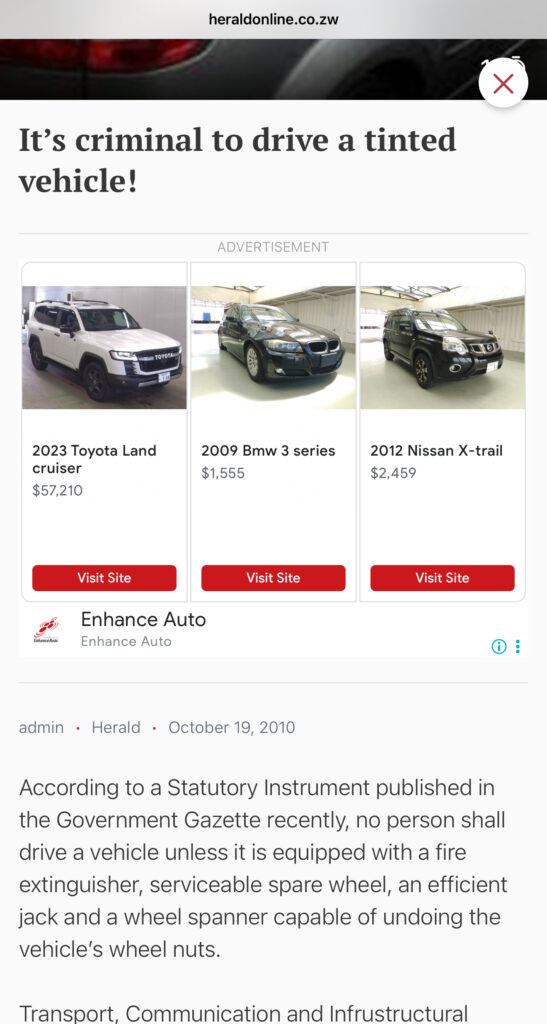
Interestingly, the Herald newspaper which carried the ‘No law banning tinted vehicle windows’ story, is on record with an ‘It’s criminal to drive a tinted vehicle!’ article from years back.
Conclusion
With the available evidence, the claim that, ‘At the moment, we do not have any law banning tinted windows on vehicles’ has been rated misleading. This is because SI 129/15 does ban tinted windows on vehicles in certain circumstances. While it is true that this is not a blanket ban, it does ban tinted windows that do not ensure a safe degree of visibility and are not permanently marked with the name or trademark of the manufacturer or with the trade name of the glass, clearly identifying it as safety glass.
The minister acknowledges that there is a law on tinting but implies that this does not apply to windows. This is misleading as the relevant law explicitly states ‘windscreens and windows’.
While the politicians and lawyers sort this out, it remains unclear what is in store for the motoring public. Will the police continue to issue fines for ‘tinted and shaded windows’ or not?
But now you know, if your tinted windows offer a safe degree of visibility and are clearly and permanently marked as safety glass by the manufacturer, you don’t have to pay.