CLAIM: 35% of adults aged 18 to 59 years are overweight and obese
SOURCE: Post cabinet briefing
VERDICT: Inaccurate, it is higher than that
The World Health Organisation defines overweight as a condition of excessive fat deposits.
Obesity, on the other hand, is a chronic complex disease defined by excessive fat deposits that can impair health.
Obesity can lead to increased risk of type 2 diabetes and heart disease, it can affect bone health and reproduction, it increases the risk of certain cancers. Obesity influences the quality of living, such as sleeping or moving.
The diagnosis of overweight and obesity is made by measuring people’s weight and height and by calculating the body mass index (BMI): weight (kg)/height² (m²). The body mass index is a surrogate marker of fatness and additional measurements, such as the waist circumference, can help the diagnosis of obesity.
The BMI categories for defining obesity vary by age and gender in infants, children and adolescents.
For adults, WHO defines overweight and obesity as follows:
- overweight is a BMI greater than or equal to 25; and
- obesity is a BMI greater than or equal to 30.
However, the current BMI classification system has been, in some quarters, considered misleading about the effects of body fat mass on mortality rates, according to an AMA Council on Science and Public Health report presented at the 2023 AMA Annual Meeting in Chicago.
“Numerous comorbidities, lifestyle issues, gender, ethnicities, medically significant familial-determined mortality effectors, duration of time one spends in certain BMI categories and the expected accumulation of fat with aging are likely to significantly affect interpretation of BMI data, particularly in regard to morbidity and mortality rates,” says the council’s report. “Further, the use of BMI is problematic when used to diagnose and treat individuals with eating disorders because it does not capture the full range of abnormal eating disorders.”
For adults, measuring BMI and waist circumference may be a better way to predict weight-related risk. But for children, there is no good reference data for waist circumference, which makes BMI-for-age the gold standard.
“There are numerous concerns with the way BMI has been used to measure body fat and diagnose obesity, yet some physicians find it to be a helpful measure in certain scenarios,” said AMA Immediate Past President Jack Resneck, Jr. MD. “It is important for physicians to understand the benefits and limitations of using BMI in clinical settings to determine the best care for their patients.”
A growing pandemic in Zimbabwe?
Recently, the issue of obesity has come onto the spotlight after being flagged in a post cabinet briefing.
Permanent secretary in the information ministry, Nick Mangwana, also flagged this on his X account.
The reactions were varied. They ranged from those who felt that there were more pressing issues for government to focus on, to those who dismissed it as untrue and those who agreed that this was a growing health concern.
The most recent Zimbabwe Demographic and Health Survey 2023-24 paints a grim picture; ‘51% of women age 20–49 are overweight or obese, and 5% are thin. Among adolescent women age 15–19, 16% are overweight or obese and 12% are thin. Among men age 20–49, 17% are overweight or obese and 10% are thin. Two percent of adolescent men age 15–19 are overweight or obese, and 38% are thin’.
The findings from the Zimbabwe Livelihoods Assessment Committee are even more stark; ‘Nationally, 50% of the adults aged 18-59years were overweight and obese’.
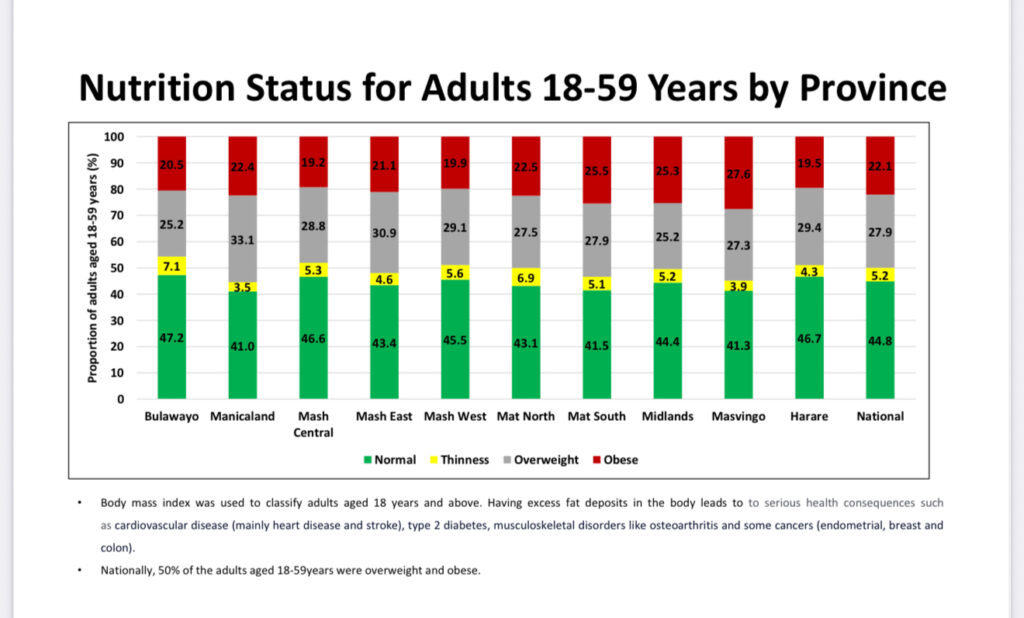
The Global Nutrition Report agrees that Zimbabwe does have an obesity problem:
‘Zimbabwe has shown limited progress towards achieving the diet-related non-communicable disease (NCD) targets. 27.9% of adult (aged 18 years and over) women and 5.6% of adult men are living with obesity. Zimbabwe’s obesity prevalence is higher than the regional average of 20.8% for women but is lower than the regional average of 9.2% for men. At the same time, diabetes is estimated to affect 8.1% of adult women and 7.3% of adult men’.
And this is not a recent issue.
An analysis using data from the 2015 Zimbabwe Demographic and Health Survey, Societal risk factors for overweight and obesity in women in Zimbabwe: a cross-sectional study, showed that the prevalence of overweight and obesity among women in the country was high.
The study concluded that, ‘The key social factors associated were older age, being married, being wealthy and the use of hormonal contraception. Having a higher education and being Christian also increased the risk of being obese and overweight respectively. The design of multi-faceted overweight and obesity reduction programs for women that focus on increasing physical activity and strengthening of social support systems are necessary to combat this epidemic’.
Similarly, a 2025 report by UNICEF, Overweight and Obesity A landscape analysis for Zimbabwe, shows the same trends:
‘The prevalence of overweight and obesity among women aged 15-49 years has reached 34.9% in 2015, up from 31.3% in 2010. There is a significant age disparity, with 13.3% of women aged 15-19 years affected compared to 54% in women 40-49 years.
Similarly, among men aged 15-49, the prevalence of overweight and obesity has risen to 12% in 2015, up from 9% in 2010. Moreover, men’s risk of developing overweight and obesity triples as they age, with men 40-49 years having a threefold risk compared to their younger counterparts aged 15-19 years. Although the prevalence of overweight and obesity is lower in men, it is experiencing a more rapid increase (CAGR 7.8%) compared to women (CAGR 3.2%).
‘Overweight and obesity has been shown to be moreprevalent in urban areas than rural areas. 1 in 2 urban women are either overweight or obese, with women 15-49 years with prevalence of overweight and obesity is 46.4% and in rural areas at 27.2%. Similarly, urban men have a prevalence of 20.9% compared to their rural counterparts at 7.3% as of 2015.
’A higher socio-economic status increases the risk of overweight and obesity in Zimbabwe with 49.7% of women from the highest wealth index overweight or obese compared to 19.3% in women from the lowest wealth index. Similarly, 26.1% of men 15-49 years with a higher wealth index are affected compared to 4.5% in men from the lowest wealth index.’
Conclusion
While cabinet put the overweight and obese population for adults between 18-59 years at 35%, evidence from the most recent reports show that it is way higher. The ZimLAC Urban assessment report (2024) puts the figure at 50%.
The ZDHS (2023-24) states that ‘51% of women age 20–49 are overweight or obese, while among men age 20–49, 17% are overweight or obese’.
The issue of obesity is more than just about body shaming. There is a real cost to it.
According to a UNICEF analysis report, ‘‘Overweight and obesity is a significant risk factor for non-communicable diseases (NCDs) like cardiovascular diseases (CVDs), type-2-diabetes and some cancers. The prevalence of NCDs is rising in the country, with 1 in 3 deaths (39%) in Zimbabwe due to NCDs (WHO, 2023). The social impact of overweight and obesity in children includes bullying and stigma and an early onset of NCDs (UNICEF, 2021). Furthermore, the economic costs due to overweight and obesity are substantial with an estimated USD$341.76 million in total costs. Direct and indirect costs made up 13.8% and 86.2% of total costs respectively in 2019 alone. By 2060, economic impacts are predicted to increase to USD$1.88 billion (World Obesity Federation, 2022)’.