As Zimbabwe celebrated its Heroes and Defence Forces this week, there were a lot of pictures and videos from the Liberation war being shared on social media platforms.
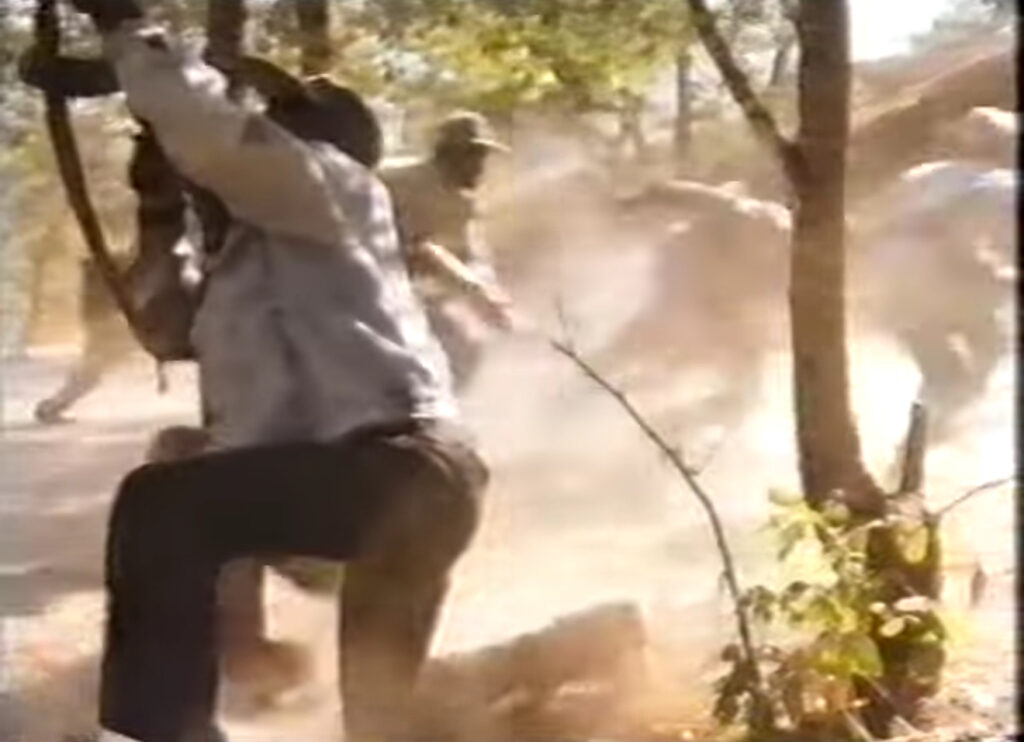
One of the posts on Facebook left people wondering if it was real. The video shows an aerial attack on a ground camp. The comments on that video ranged from, ‘But,,,, l have a question, who took this video in such a chaotic situation,,,,,,,,🤔🤔🤔’ to ‘This was real. Ndanzwa munhu achiridza mhere (I heard someone screaming). I worked with someone who was there when it happened . Upto now i can still feel the fear mai Wamambo used to have whenever an aeroplane passed. May the souls of those who sacrificed their lives continue to rest in peace.‘
Others pointed out that this was a scene from a movie, ‘A clip from a movie. There wouldn’t be time for video filming on the ground, baba!’
Flame
The video is, indeed, part of the footage from the movie, Flame. The aerial attack scene starts on the movie from the 1.01.47 mark to 1.03.00.
Below are facts about the movie Flame.
Title: Flame
Year of Release: 1996
Genre: Drama, War
Director: Ingrid Sinclair
Screenwriter: Ingrid Sinclair, Barbara Jago, Philip Roberts
Language: Shona, English
Synopsis: Flame is a film that follows the story of Florence “Flame” Ncube and her best friend, Liberty, as they join the Zimbabwe War of Liberation as young women. The movie chronicles their experiences from the initial idealism of joining the struggle to the harsh realities they face as female combatants. The narrative explores themes of patriotism, sacrifice, betrayal, gender inequality, and the psychological and physical scars left by war. The story is told through flashbacks as Flame, now an adult, reflects on her past.
- The Female Experience in War: Flame is notable for its focus on the often-overlooked role of women in the liberation struggle. It highlights their contributions as soldiers, medics, and supporters, while also exposing the sexual violence, abuse, and gender-based discrimination they faced within their own ranks.
- Betrayal and Post-War Trauma: The film explores the sense of betrayal felt by many who fought in the war, particularly women, who found that the promises of equality and a new life were not fully realised in post-independence Zimbabwe. The psychological and physical trauma of war is a central element of the narrative.
- Historical and Political Context: The movie provides a critical, though fictionalised, perspective on the Liberation War, offering a raw and unflinching look at the complexities of the conflict.
Controversy and Significance:
- Flame was the first feature-length film to be made in Zimbabwe after independence that directly addressed the liberation war from an African perspective.
- The film generated significant controversy upon its release in Zimbabwe. The government of President Robert Mugabe initially banned it, citing concerns that its portrayal of sexual abuse and political disillusionment within the liberation movement was “unpatriotic” and insulting to war veterans.
- The ban was eventually lifted, but the controversy brought international attention to the film and its critical themes.
- Flame is considered a landmark film in Zimbabwean cinema and African cinema more broadly, for its bold and uncompromising exploration of a sensitive and often mythologised historical event.
Cast:
- Marian Kunonga
- Ulla Mahaka
- Dick Chinx Chingaira
- Moise Matura
- Flame was screened at various international film festivals and received critical acclaim.
- It won the Grand Prize at the Amiens International Film Festival in France.
Legacy:
- Flame remains a vital piece of cinema for understanding the complex history of Zimbabwe’s liberation struggle.
- It is frequently used in academic settings to discuss African history, post-colonial studies, and the role of women in armed conflict.
- The film’s legacy lies in its courage to challenge a dominant national narrative and to give a voice to those whose stories were often silenced.
Conclusion
Although the video in question is from the movie Flame, it is a depiction of real life events from the liberation war.